 Stylez
Understanding the emotional, neurological, and cultural forces that shape our music preferences
Music is one of humanity’s oldest art forms, a universal language that transcends geography, culture, and even time. People across the world experience joy, comfort, nostalgia, excitement, and even healing from the songs they love. But why do we love certain pieces of music? Why do some melodies feel instantly addictive while others barely register? And why do our favorite songs seem capable of capturing our identity, shaping our emotions, and transporting us back to specific moments in our lives?
Modern psychology, neuroscience, and sociology all point to a complex cocktail of factors—from brain chemistry and early childhood exposure to cultural cues, personality traits, and even mathematical patterns in sound. This article explores the deep psychological roots behind musical attachment and examines why certain songs resonate so deeply with us, especially in Western and globalized music cultures.
Music and the Brain: A Chemical Symphony
When you hear a song you love, your brain experiences a surge of biochemical activity. The most prominent chemicals involved are dopamine, oxytocin, endorphins, and serotonin—the same chemicals involved in reward, bonding, pleasure, and mood regulation.
Dopamine: The Reward Chemical
Researchers at McGill University discovered that listening to pleasurable music releases dopamine in the striatum—the same region activated by food, sex, and addictive substances. Anticipation of a beat drop, instrumental climax, or lyrical hook creates a tension-and-release cycle that the brain interprets as rewarding.
This is why:
- A powerful chorus can give you goosebumps
- A familiar intro can make you smile before the lyrics even start
- You replay the same song repeatedly without getting bored
Music literally hijacks the brain’s reward system.
Prediction and Surprise
Our brains constantly make predictions. Good music plays with this system.
In Western pop, this often takes the form of:
- Predictable chord progressions (e.g., I–V–vi–IV)
- A catchy hook that repeats
- A beat drop after the build-up
- Unexpected harmonies or melodic turns
We derive pleasure from music because it blends the familiar (predictable) with the surprising (novel).
The Neuroscience of Repetition
The “mere exposure effect” states that the more we hear something, the more we tend to like it. Record labels, advertisers, and streaming algorithms understand this well, exposing listeners to songs repeatedly until they “click.”
This is why many hit songs in the U.S. and Europe rely on:
- Repetitive choruses
- Memorable motifs
- Simple lyrics
- Short runtimes that encourage looping
Your brain becomes comfortable with songs that feel recognizable, even after only a few listens.
Memory, Nostalgia, and Emotional Anchors
Some songs feel emotionally powerful far beyond their musical content. That’s because music acts as a memory anchor.
Music as Emotional Time Travel
Hearing a song tied to a specific moment—your first kiss, a road trip, a heartbreak—activates the hippocampus, a brain region responsible for memory.
This helps explain why:
- Older adults cherish the music from their teens and early twenties
- Certain melodies can trigger vivid childhood memories
- You associate songs with seasons, places, or people
Music becomes a soundtrack to your life.
Why Teenage Music Stays With Us
Studies show that between ages 12–25, the brain experiences heightened neuroplasticity, emotional sensitivity, and identity formation. The songs we hear during this period often remain our lifelong favorites.
This explains phenomena such as:
- Millennials loving early 2000s pop-punk
- Gen Z’s attachment to late 2010s hip-hop and bedroom pop
- The global resurgence of “throwback” playlists
Our favorite songs often serve as emotional anchors, reminding us of who we were.
Culture, Identity, and Social Belonging
Music shapes identity and cultural belonging, particularly in Western and globalized societies.
Music as a Social Identity Marker
People often identify themselves through genres:
- Punk fans = rebellion
- Hip-hop fans = authenticity and street culture
- EDM fans = communal energy
- Indie fans = creativity and emotional depth
- Country fans = storytelling and tradition
Loving a certain type of music can signal your values, personality, and social tribe.
Cultural Exposure
You are more likely to enjoy music you’ve been culturally exposed to. This is why Western audiences tend to gravitate toward:
- Western chord structures
- English lyrics
- Pop production styles
At the same time, globalization has diversified Western tastes, making genres like K-pop, Afrobeats, Latin trap, and Bollywood pop increasingly popular.
Music and Social Bonding
Humans evolved to form social bonds through synchronized vocalization and movement—singing and dancing.
This is why:
- Concerts feel euphoric
- National anthems unite crowds
- Singing in groups boosts oxytocin
- Fans feel deeply connected to artists and communities
Music strengthens belonging, a core human need.
Personality and Music Preferences
Psychology shows clear correlations between personality traits and preferred genres.
The Big Five Traits and Music
Research from Cambridge and other institutions has found patterns like:
- Openness to experience: jazz, classical, indie, world music
- Extraversion: pop, hip-hop, dance, EDM
- Agreeableness: soft rock, country, singer-songwriter
- Neuroticism: emotional pop, emo, alternative, lo-fi
- Conscientiousness: upbeat pop, motivational songs
While not absolute, these trends highlight the role of personality in shaping our musical tastes.
Lyrical Connection and Emotional Resonance
Lyrics can make or break a song for many listeners.
Emotional Relatability
We love songs that reflect our experiences—love, loss, ambition, anxiety, empowerment.
This is why Taylor Swift, Adele, Billie Eilish, and many Western artists resonate so deeply: their lyrics articulate feelings listeners can’t always express themselves.
Storytelling
Narrative-driven songs—common in country, folk, and ballads—create emotional engagement by telling relatable stories.
Ambiguity and Interpretation
Songs with ambiguous or metaphorical lyrics allow listeners to project their own meaning, making them feel more personal.
Rhythm, Tempo, and the Body’s Response
Music doesn’t just affect the brain—it affects the body.
Entrainment
Humans naturally synchronize to rhythm. Heart rate, breathing, and even brainwaves can align to a song’s tempo.
Upbeat tempos energize
Slow tempos relax
Strong basslines can stimulate motor regions
This physiological effect is why certain songs feel “irresistible” to dance or move to.
The Power of the Beat
In Western pop and EDM, the beat serves as the emotional engine of the track:
- Heavy bass triggers the vestibular system
- Four-on-the-floor rhythms activate motor coordination
- Build-ups create emotional anticipation
Your body feels the song as much as your ears hear it.
The Role of Technology and Algorithms
Streaming platforms like Spotify, Apple Music, and YouTube shape modern tastes on a massive scale.
Algorithmic Exposure
Algorithms learn what you like and feed you similar music, reinforcing preferences and introducing you to new artists with similar sonic characteristics.
This has contributed to:
- The dominance of certain chord progressions
- Homogenization of pop production
- Viral hits driven by TikTok moments
- Fast-rising artists due to playlist placements
While some see this as reducing diversity, others view it as democratizing music discovery.
TikTok’s Influence
Short-form platforms favor catchy hooks, making:
- Short intros
- Repetitive choruses
- Memorable one-liners
more popular than ever.
The platform has reshaped what “hit songs” sound like in the U.S. and Europe.
The Emotional Architecture of Songwriting
Great songs are engineered to manipulate emotions in predictable ways.
Chord Progressions
Minor chords evoke sadness or mystery.
Major chords evoke joy or optimism.
The contrast between major and minor is emotionally powerful, used heavily in pop, rock, and film scores.
Melodic Contour
Ascending melodies often feel hopeful or uplifting.
Descending melodies feel melancholic or contemplative.
Instrumentation
- Strings = emotion
- Acoustic guitar = intimacy
- Synths = nostalgia or futurism
- Drums = energy
Producers craft emotional journeys through sound selection alone.
Why “Guilty Pleasure” Songs Exist
Many people enjoy songs they feel embarrassed to admit. This phenomenon occurs when:
- A song triggers nostalgia
- The melody is catchy
- The lyrics are relatable
- The beat is addictive
Your conscious mind may judge it, but your subconscious brain doesn’t care—it likes what it likes.
The Uniquely Human Bond With Music
Despite technological evolution, music remains deeply tied to our humanity.
We love certain songs because they:
- Shape our identity
- Reflect our emotions
- Connect us socially
- Activate brain chemicals
- Provide comfort and meaning
- Capture memories
- Communicate what words can’t
Music is both science and art, both emotion and memory, both cultural and biological. And while our individual preferences vary, the underlying reasons we love music are shared across cultures and generations.
The Psychology Behind Your Favorite Song
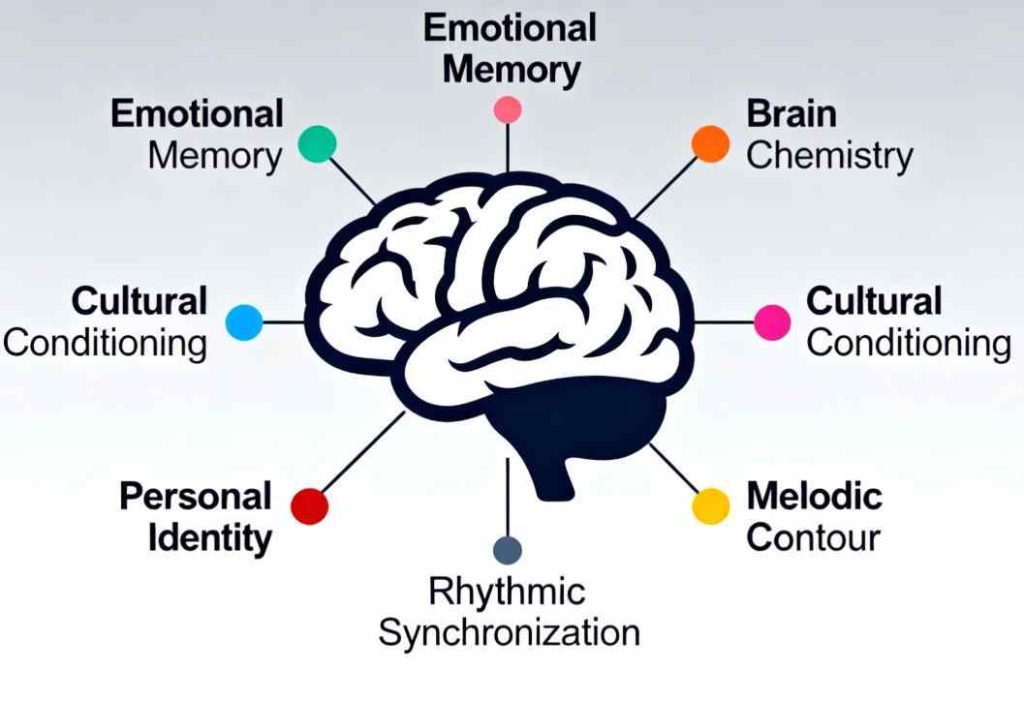
The songs you love are not just random preferences. They are the result of:
- Your brain’s reward system
- Your upbringing and cultural environment
- Your emotions and personal history
- Your personality
- Your biology and body responses
- The social connections music creates
Understanding why you love certain songs can help you understand more about yourself—your memories, your identity, and your emotional world.
Music is not just something we listen to.
It’s something we feel, something we live, and something that becomes part of who we are.